Eugenics Sterilization Pamphlet
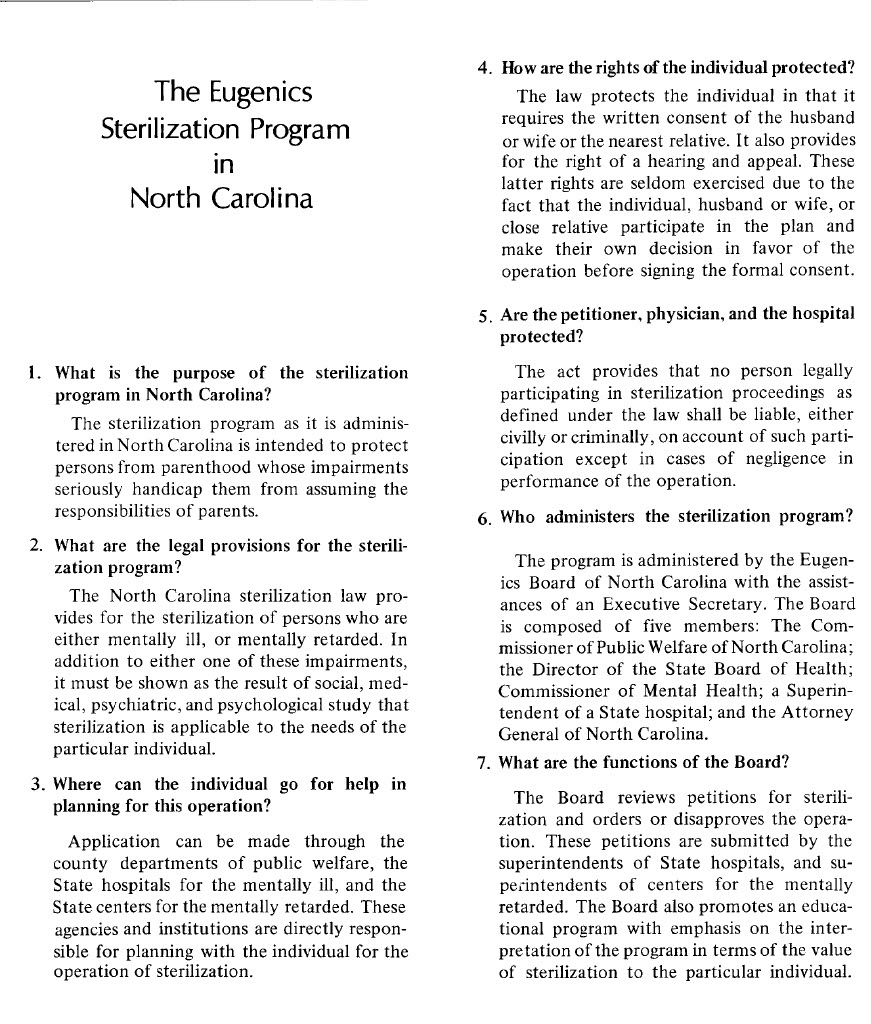
1 media/DOC04_Pamphlet_thumb.jpg 2024-04-26T22:37:14+00:00 Gianna May Sanchez b6deef7be4c4843975b8218d24ae92e68f945198 439 1 Pamphlet promoting and describing sterilization proceedures in North Carolina The Eugenics Sterilization Program in North Carolina 1. What is the purpose of the sterilization program in North Carolina? The sterilization program as it is administered in North Carolina is intended to protect persons from parenthood whose impairments seriously handicap them from assuming the responsibilities of parents. 2. What are the legal provisions for the sterilization program? The North Carolina sterilization law provides for the sterilization of persons who are either mentally ill, or mentally retarded. In addition to either one of these impairments, it must be shown as the result of social, medical, psychiatric, and psychological study that sterilization is applicable to the needs of the particular individual. 3. Where can the individual go for help in planning this operation? Application can be made through the county departments of public welfare, the State hospitals for the mentally ill, and the State centers for the mentally retarded. These agencies and institutions are directly responsible for planning with the individual for the operation of sterilization. 4. How are the rights of the individual protect? The law protects the individual in that it requires the written consent of the husband or wife or the nearest relative. It also provides for the right of a hearing and appeal. These latter rights are seldom exercised due to the fact that the individual, husband or wife, or close relative participate in the plan and make their own decision in favor of the operation before signing the formal consent. 5. Are the petitioner, physician, and the hospital protected? The act provides that no person legal participating in sterilization proceedings as defined under the law shall be liable, either civilly or criminally, on account of such participation except in cases of negligence in performance of the operation. 6. Who administers the sterilization program? The program is administered by the Eugenics Board of North Carolina with the assistances of an Executive Secretary. The Board is composed of five members: The Commissioner of Public welfare of North Carolina; the Director of the State Board of Health; Commissioner of Mental Health; a Superintendent of a State hospital; and the Attorney General of North Carolina. 7. What are the functions of the Board? The Board reviews petitions for sterilization and orders or disapproves the operation. These petitions are submitted by the superintendents of State hospitals, and superintendents of centers for the mentally retarded. The Board also promotes an educational program with emphasis on the interpretation of the program in terms of the value of sterilization to the particular individual. plain 2024-04-26T22:37:14+00:00 Gianna May Sanchez b6deef7be4c4843975b8218d24ae92e68f945198This page has annotations:
- 1 2024-04-26T22:39:24+00:00 Gianna May Sanchez b6deef7be4c4843975b8218d24ae92e68f945198 Eugenics Sterilization Pamphlet Transcript Gianna May Sanchez 1 Transcript of a pamphlet promoting and describing sterilization proceedures in North Carolina plain 2024-04-26T22:39:24+00:00 Gianna May Sanchez b6deef7be4c4843975b8218d24ae92e68f945198
This page is referenced by:
-
1
media/NC-eugenics-board-1024x668.jpg
2020-06-17T16:36:07+00:00
The Eugenics Board of North Carolina
7
plain
2024-06-13T23:25:54+00:00
The North Carolina Supreme Court established the Eugenics Board of North Carolina in 1933 after the Brewer v. Valk case in 1933, where a 1929 law strengthening eugenic sterilization was ruled as unconstitutional. The decision claimed that sterilization proceedings in North Carolina did not have provisions to allow for a hearing or right to appeal for individuals ordered to undergo sterilization. Members of the Eugenics Board included the State Commissioner of Public Welfare, the Secretary of the State Board of Health, the Attorney General, and medical professionals from state hospitals and institutions for “feebleminded” patients. Meetings occurred once a month, except in special hearing cases, to consider sterilization petitions from institutional and non-institutional actors. The Board approved 6,802 sterilization operations between July 1933 and June 1966, although 49 additional operations reportedly took place prior to the formation of the Eugenics Board. (Eugenics Board of North Carolina, Biennial Report, 1966) Sterilizations did decrease after 1966, but the Eugenics Board was not disbanded until 1977.
In 2011, the Governor’s Eugenics Compensation Task Force created a system of restitution for sterilization victims and estimated that the Eugenics Board oversaw the sterilization of almost 7,600 total individuals between January 1929 and December 1974. (Governor’s Task Force, 2012, p.6) Although the annual number of sterilizations generally decreased on a national level after World War II, North Carolina’s Eugenics Board increased the number of performed operations during the 1950s and 1960s and reported the highest number of biennial operations between 1950 and 1952. (Schoen, 2005, p.80; Eugenics Board of North Carolina, Biennial Report, 1966, p.25) The Eugenics Board accepted sterilization petitions from a range of North Carolina’s institutions and actors including state hospitals, jails and prisons, youth reform schools, homes to address statewide poverty, local social workers, and public welfare agencies.
Reports from North Carolina showed that state’s eugenic sterilization program highly impacted young, single women, with a particular focus on women in poverty and recipients of public welfare. The Eugenics Boards’ approved operations demonstrated that race, class, and ideas about disability informed who was thought of as “unfit” for reproduction, and heavily impacted African American women. In promotional materials, the Board argued that sterilization would “protect persons from parenthood whose impairments seriously handicap them from assuming the responsibilities of parents.” Ideas that low intelligence, disabilities, poverty, criminal inclinations, and addiction could be inherited characterized eugenic beliefs about who should have children. Physicians and public health officials petitioned the Eugenics Board for patient sterilizations in state hospitals, but public welfare officials and social workers could also refer local welfare recipients for these procedures. Women who birthed children outside of marriage, had multiple children, or used public assistance funds to support their families were especially targeted for sterilization. Eugenicists in public health and social welfare programs argued that these women and their children were “public charges” and cost the state money to support, and warned that their children were likely repeat the same pattern.
Additionally, The Eugenics Board ordered sterilization procedures for African Americans throughout the twentieth century but after 1956, state officials began to sterilize more African American women than white women even though the white population in the state was much larger than the African American population. African Americans could not receive welfare relief in the 1930s and 1940s because of racial discrimination, but federal pressure in the 1950s to include African American people in social programs increased the population’s contact with public welfare officials who could refer clients for sterilization, even if the individuals were not in hospitals, prisons, or youth reform schools. North Carolina’s eugenic sterilization program’s actions to end the reproductive abilities of individuals deemed unfit on the basis of ability, class, and race were not unique when compared to other state programs, but it does shows us an example of how sterilization programs took place in a state with a notable African American population.
Social organizations that supported eugenic sterilization worked to publicly increase support for controlling the reproductive rights of “unfit” individuals. The Human Betterment League of North Carolina chapter was involved in various campaigns including sending pamphlets that advocated for sterilizing more individuals to lawmakers and powerful people in the state. The Human Betterment League also wrote opinion editorials in newspapers supporting sterilization and took out large spaces in newspapers across the state to convince the public that sterilization would limit the number of “mental defectives” that could reproduce and pass on “a needless and tragic heritage.” Eugenic groups described sterilization as a procedure that would only benefit society and potentially help prevent future generations. Dr. Clarence J. Gamble worked with the Human Betterment League to spread its influence, published eugenicist findings in medical journals, and offered funds to the Eugenics Board of North Carolina to support studies that would argue for the necessity of sterilization programs. These organizations thus established methods to influence the Eugenics Board and attempted to shape public perceptions of sterilization.
While some women and men asked for sterilization referrals to aide their family planning decisions, other individuals rejected the procedure and sometimes hearings occurred in cases when individuals or families refused consent. In 1950, sociologist Moya Woodside wrote Sterilization in North Carolina. While her work was in favor of eugenic sterilization and the Eugenics Board, it also shows that many medical professionals and social workers could not make people accept the idea that sterilization was a good decision for themselves or their families. Woodside noted that many social workers blamed “ignorance and superstition” and “uneducated country people” as complications to carrying out the sterilization program. (Woodside, 1950, p.61) One quoted welfare superintendent stated: “There is still so much ignorance and superstition and fear among feebleminded clients and relatives where any mention is made for sterilization that it is next to impossible help them dispel these reactions.” (Woodside, 1950, p.62) The interviews and social agency cases that Woodside quoted, however, showed that individuals in North Carolina had a great number of reasons to reject the operation. For example, one woman rejected a social worker’s suggestion for sterilization because she stated that her sister was sterilized when she was twenty-five years old and “lost her mind” after. (Woodside, 1950, p.62) Some individuals expressed religious opposition to sterilization and resisted the procedure. In other cases, Woodside explained that family members sometimes objected to the procedure and would not give consent. One welfare superintendent offered one instance in which “‘One [feebleminded] Negro girl had not been sterilized because of resistance from relatives. They did not think it fair to take away the right to have children.’” (Woodside, 1950, p.73) Although Woodside’s research was meant to support sterilization, we can read her work to see how people in North Carolina struggled against the Eugenics Board, social workers, and welfare agencies.