Eugenics Tree
1 media/GDTI11_EugenicsTree_thumb.jpg 2023-03-03T22:08:40+00:00 Gianna May Sanchez b6deef7be4c4843975b8218d24ae92e68f945198 439 1 Illustration of the different subfields that eugenics theories draw from. The illustration features a large tree with a top header that reads “Eugenics.” In between the tree's branches and roots, there is text that reads “Eugenics is the Self Direction of Human Evolution.” In the trees roots, different fields and research are written, including: Anatomy, Physiology, Psychology, Biology, Genetics, Mental Testing, Anthropometry, History, Geology, Anthropology, Archaeology, Ethnology, Geography, Law, Politics, Statistics, Economics, Biography, Genealogy, Education, Sociology, Religion, Medicine, Surgery, and Psychiatry. The caption under the illustration reads: “Like a tree Eugenics draws its materials from many sources and organizes them into an harmonious entity.” plain 2023-03-03T22:08:40+00:00 New York 1923 English NW Harry H. Laughlin, “Copy of Certificate Awarded for Meritorious Exhibits,” Second International Exhibition of Eugenics, Second International Congress of Eugenics in the American Museum of Natural History (Williams and Wilkins Company, 1923): 15. Harry H. Laughlin Second International Congress of Eugenics 1923 illustration Williams and Wilkins Company Fair Use Williams and Wilkins Company Cropped by SSJ Lab Member, March 2023 Gianna May Sanchez b6deef7be4c4843975b8218d24ae92e68f945198This page is referenced by:
-
1
media/Nc-county-eugenics-july-1946-1968.jpg
2021-05-21T15:57:43+00:00
North Carolina Eugenics Law
9
Overview of Eugenic Sterilization Laws in North Carolina
plain
2025-07-10T18:22:13+00:00
In 1929, North Carolina passed a eugenic sterilization law that permitted the sterilization of individuals who were “mentally diseased, feeble minded, or epileptic” and whose sterilization the state considered to be “in the interest of the mental, moral, or physical improvement of the patient or inmate or for the public good.”[1] North Carolina’s law was part of a nationwide effort to eliminate “feeblemindedness” and the social problems that accompanied it by drawing on both eugenic science and the development of intelligence testing. Eugenic science gained the ear of policymakers in the last quarter of the nineteenth century when many feared that immigration and the development of birth control threatened a United States dominated by a native-born white population. During the 1910s and 1920s, eugenicists helped to shape legislation that aimed to stem this perceived threat by restricting marriage, controlling immigration, and sterilizing members of the community who they considered to be undesirable.
During the initial years after North Carolina’s law passed, state officials made only half-hearted use of it. But in 1932, a lawsuit surrounding the sterilization of Mary Brewer, a twenty-eight-year-old mother of five, resulted in the redrafting of the state sterilization statute and the formalization of sterilization procedures. The new law, introduced by a member of the Board of Directors of Caswell Training School, a state mental health institution, established a state Eugenics Board composed of the commissioner of public welfare, the secretary of the State Board of Health, the chief medical officers of the State Hospital in Raleigh and of an institution of the feebleminded or the insane, and the attorney general of North Carolina. The board received petitions for sterilization from the state’s penal and charitable institutions and from county superintendents of public welfare, and it voted on the authorization of these petitions. As the only state in the nation that gave social workers the power to file sterilization petitions, North Carolina’s eugenic sterilization program represented the state's financial interest in sterilization more clearly than any other state program did.
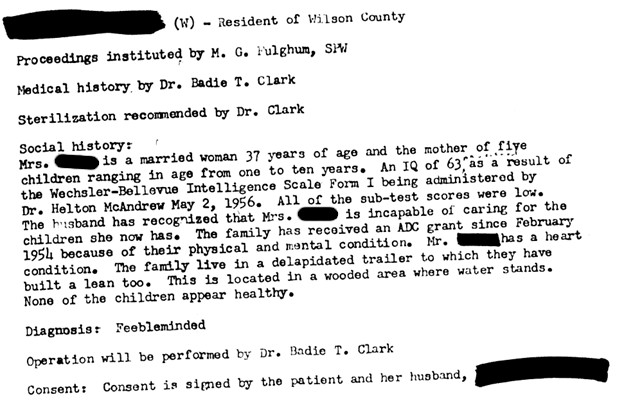
With the passage of the state’s eugenic sterilization law, health and welfare officials in charge of implementing the program began to bring their own policy goals to the table. Since the directors of mental institutions as well as social workers could submit sterilization petitions, these goals ranged from controlling welfare spending to improving the health of sterilization candidates to easing institutional overcrowding by sterilization and then releasing inmates of the state’s training schools. Having identified an individual as being in need of eugenic sterilization, petitioners put together sterilization petitions that contained information about clients' social, medical, and eugenic history and submitted the applications to the North Carolina Eugenics Board. At monthly board meetings, Eugenics Board members would review these petitioners and vote on sterilization decisions. Once the board authorized a petition, the case was assigned to the hospital closest to the patient, where staff surgeons performed the operation. While some hospitals and surgeons might have been more likely than others to come in contact with eugenic sterilization, the surgeons assigned to such cases had no special link with the state sterilization program; they encountered the sterilizations as part of their regular workload.
Sterilization candidates or their legal guardians had to consent to sterilization. If they failed to do so, the Eugenics Board would call a hearing at which family members could voice their opposition to the procedure. Some family members took advantage of this opportunity and came, with or without lawyers, to voice their objections or to seek further clarification about the surgery. If, following the hearing, board members still believed that eugenic sterilization was advisable, they could authorize the surgery over the patient’s or the patient’s guardian’s objections. Most patients and guardians, however, did not attend the hearing. In these cases, a hearing served as a legal formality that allowed the Eugenics Board to authorize a sterilization despite the lack of consent. Theoretically, the state had the power to force individuals by court order to submit to the surgery once it had been authorized. In practice, however, state authorities were hesitant to resort to outright force. If patients did not submit to sterilization orders, state authorities either rested the cases or filed new petitions at a later date in the hope that families would change their minds.[1] North Carolina State Board of Public Welfare, “Eugenical Sterilization,” North Carolina Welfare Laws Bulletin 24 (1944): 150.