Playground
1 media/PH08_Playground_thumb.jpg 2023-09-29T23:31:46+00:00 Gianna May Sanchez b6deef7be4c4843975b8218d24ae92e68f945198 439 2 An image published in a newspaper about mothers on welfare. It depicts seven African American children, playing on a backyard porch. They appear to be dancing. The wooden porch they stand on appears to be fairly cluttered. One of the children, a young girl, that is closest to the camera, but facing away, is barefoot and wearing a short dress and cardigan. Another girl is to the left of the other child, facing the camera directly and smiling. Behind the first girl, there appear to be two more figures that are dancing, but it is difficult to identify any details. To the right of these four children, a young boy faces right with his left arm raised. He appears to be singing or shouting. He is wearing a striped, long sleeve shirt and jeans. Next to him, a younger boy of around six or seven stands at the edge of the porch, smiling. Finally, another older girl is to the far right of the photograph, facing the camera with pursed lips. It looks as if she is playing an instrument. The caption under the photograph reads: "This is the playground out back for these youngsters." plain 2023-09-29T23:34:18+00:00 NC July 25, 1965 English North Carolina Joe Goodman, “Poverty Program Means Different Things to People,” Winston-Salem Journal, 25 July 1965. Joe Goodman 1965 newspaper Winston-Salem Journal Fair Use Winston-Salem Journal Cropped and prepped for online display by SSJ Lab Member September 2023 Gianna May Sanchez b6deef7be4c4843975b8218d24ae92e68f945198This page is referenced by:
-
1
media/PH08_Playground.jpg
2023-09-29T23:12:40+00:00
Welfare and Promiscuity
4
plain
2023-09-29T23:37:00+00:00
Fears about the rising cost of welfare through the Aid to Dependent Children (ADC) program led to a significant shift in the racial composition of those targeted for eugenic sterilization in North Carolina. The proportion of state-sterilized patients in North Carolina who were African American rose from 23 percent in the 1930s and 1940s to 59 percent between 1958 and 1960 and finally to 64 percent between 1964 and 1966. While discriminatory welfare practices of the 1930s and 1940s had excluded African Americans from ADC programs and left them largely outside social workers’ sphere of influence, federal pressure and a series of new requirements relating to the implementation of ADC resulted in black women’s inclusion in social service programs, bringing them into closer contact with social workers and thus with state-supported sterilization. Nationwide, the percentage of welfare recipients who were African American rose from 31 percent in 1950 to 48 percent in 1961. The addition of Hispanics to the rolls produced a nonwhite majority among welfare recipients in the 1960s. It seemed especially pressing to save funds considering public assumption about African American promiscuity and poverty.
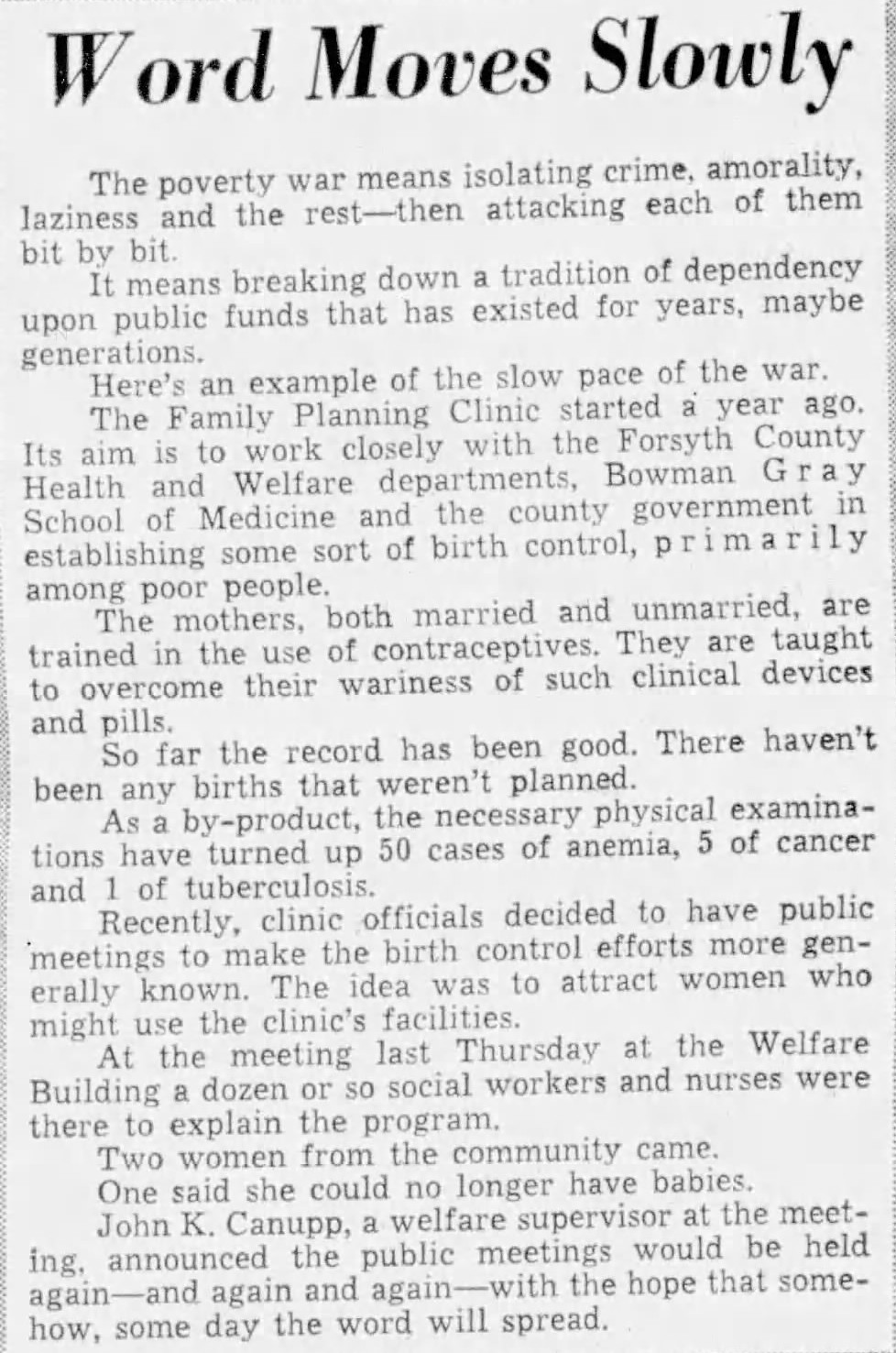
The emphasis on illegitimacy in the Black community and on the presumably uncontrolled sexual behavior of Black women reinforced racist stereotypes about the hypersexual black woman. As a larger number of African Americans became ADC recipients, the discourse about ADC mothers blamed black single mothers for urban plight, poverty, and social unrest. This discourse shifted attention away from the structural causes of poverty and crime and placed the blame for urban poverty and social unrest at the feet of African American women. Resentment of African American single mothers and the presumed burden they placed on the state culminated in a number of legislative proposals aimed at controlling the reproduction of ADC recipients. Newspaper articles that discussed this perceived issue were quick to link poverty to seemingly out of control reproduction. In 1965, the Winston-Salem Journal published a story about Black women’s experience with welfare programs and made a point to include a side column about the need for impoverished families to use birth control in order to solve their issues with poverty. To emphasize this point, the newspaper published an image of one of the mother’s children playing on a porch as apparent evidence of the link between unchecked reproduction and poverty.
To intensify the fight against poverty, Ellen Winston, North Carolina’s commissioner of public welfare, recommended in 1951 that the state expand its use of the eugenic sterilization program by following up on ADC families in which one family member had been sterilized to determine if other members might benefit from the surgery. This new policy not only led to an increase in the number of noninstitutional sterilizations but also to a sharp rise in the number of women sterilized who had given birth to children prior to having the operation. The proportion of noninstitutional sterilizations rose from 23 percent between 1937 and 1951 to 76 percent between 1952 and 1966. Sixty-six percent of patients sterilized in the 1950s and 1960s had had children prior to their sterilization, and 52 percent of them had given birth to these children outside marriage.
The new emphasis on socialization drew particular attention to the behavior of teenage girls. Social workers considered girls reared in impoverished and immoral environments to be likely to perpetuate the pattern set by their parents. Almost formulaically, social workers emphasized the inadequate supervision daughters received from their mothers; they argued, “Sterilization will prevent additional children who will never be able to realize any potential they may have because adequate care will be denied them and will restrict the third generation who are caught in this cycle of poverty and neglect.”[1]
It took until the late 1960s for North Carolina sterilization rates to decline. Changes during that decade laid the groundwork for the dismantling of state-supported sterilization. The development of more reliable contraceptives the onset of the Civil Rights and Women’s Rights Movements, and a better understanding of mental disease and intellectual disabilities all contributed to a significant shift in board members’ perceptions of eugenic sterilization. In 1974, North Carolina finally repealed its eugenic sterilization law. That same year, the Office of Economic Opportunity formulated and distributed sterilization guidelines to ensure that patients would receive adequate counseling and be given informed consent to further safeguard the poor against the possibility of sterilization abuse. But it took the state until 2003 to remove the eugenic sterilization law from the books.[1] Eugenics Board of North Carolina, Hearing, March 1961, 2, Eugenics Board Papers, North Carolina State Archives.


![[1]](https://scalar.dartmouth.edu/scalar/eugenic-states/media/SR06_NC%20Sterilization.jpg)